
AI Chatbot Development
In our continuous effort to enhance user experience and provide seamless support, we embarked on the journey of developing an AI-powered chatbot. This chatbot is designed to respond to general inquiries as well as specific questions related to our company's projects and challenges. Through meticulous research and implementation, we successfully integrated advanced AI techniques, vector databases, and optimized model architectures to create a highly efficient system. This blog details the challenges we faced and the solutions we implemented.
Challenges Faced and Solutions Implemented
-
Understanding and Context Retention
-
Challenge:
-
One of the primary challenges was enabling the chatbot to understand complex queries and maintain context throughout the conversation. Standard AI models often struggle with long-form interactions and require external memory mechanisms.
-
Solution:
-
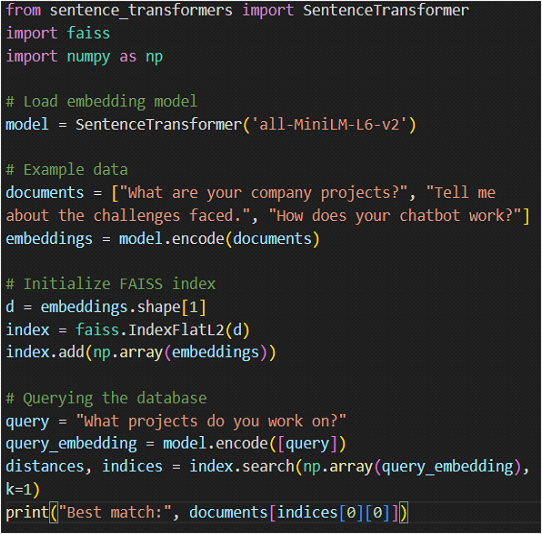
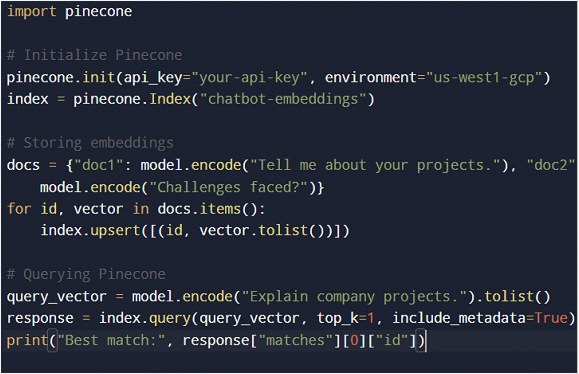
To address this, we incorporated embeddings using OpenAI's text embedding models and stored them in a vector database. This allowed us to perform semantic search and retrieve relevant responses efficiently. By leveraging FAISS (Facebook AI Similarity Search), we optimized query retrieval time, ensuring the chatbot provides responses with near-instant latency.
Python Code Implementation:
Optimizing Model Response and Accuracy
-
Challenge:
-
The default ChatGPT model required modifications to cater to our industry-specific requirements. Generic responses would not be sufficient, and fine-tuning was essential.
-
Solution:
-
We implemented a custom fine-tuned model with our proprietary dataset. Key improvements included:
-
Reinforcement Learning from Human Feedback (RLHF): This enabled the model to prioritize industry-relevant answers.
-
Temperature Control: Adjusting the temperature parameter to 0.7 ensured a balance between creativity and factual accuracy.
-
Retrieval-Augmented Generation (RAG): By combining generative AI with our vector database, we ensured the chatbot provided factually accurate responses without hallucinations.






Comments
Manish